Have you ever looked at the lines on the palm of your hand and wondered what they might mean?
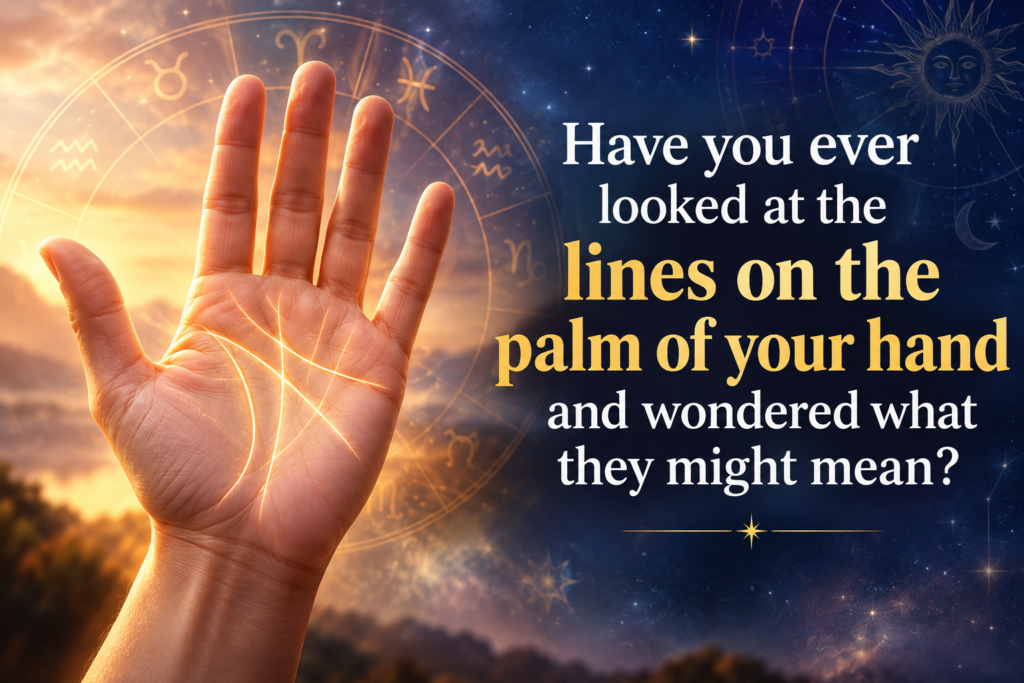
For thousands of years, people have looked to the hands for clues about personality, relationships, career, life changes, and the future. Palm reading, also called palmistry or chiromancy, is a traditional form of divination in which the shape of the hand, the lines on the palm, the fingers, and other markings are interpreted symbolically.
There are several traditions of palmistry. Western palmistry and Indian or Vedic palmistry have some similarities, but they also use different systems and interpretations. Both approaches examine the hand as a whole rather than relying on one single line.
It is important to remember that palmistry is a spiritual and cultural practice, not a scientifically proven method of predicting future events. A palm reading is best understood as an interpretation of possible tendencies, themes, and life changes rather than a guaranteed forecast.
So, what exactly does a palm reader look for?
Looking at the Hand as a Whole
Before examining individual lines, a palm reader usually studies the overall appearance of the hand.
The reader may look at the size and shape of the palm, the length of the fingers, the flexibility of the hand, the thumb, the fingertips, and the raised areas of the palm known as mounts.
The texture of the hand can also be considered. A traditional palm reader may interpret a soft hand differently from a firm or coarse hand.
The fingers can provide additional information. For example, the index finger is traditionally associated with Jupiter and qualities such as ambition and leadership. The middle finger is associated with Saturn and responsibility. The ring finger is associated with the Sun and creativity or recognition, while the little finger is associated with Mercury and communication.
The thumb is particularly important because it is traditionally associated with willpower, determination, and the ability to make decisions.
In Vedic palmistry, these observations are often connected with planetary symbolism and are used alongside the major lines.
The Mounts of the Palm
The raised areas of the palm are called mounts. In both Western and Vedic traditions, they can provide additional clues.
The Mount of Jupiter, beneath the index finger, is associated with ambition, leadership, confidence, and the desire to achieve.
The Mount of Saturn, beneath the middle finger, is traditionally connected with responsibility, discipline, seriousness, and wisdom gained through experience.
The Mount of Apollo or Sun, beneath the ring finger, is associated with creativity, recognition, self-expression, and accomplishment.
The Mount of Mercury, beneath the little finger, is traditionally connected with communication, business ability, adaptability, and intellect.
The Mount of Venus, surrounding the base of the thumb, is associated with affection, vitality, relationships, pleasure, and emotional warmth.
The Mount of Moon, along the outer lower portion of the palm, is associated with imagination, intuition, emotions, and travel.
Mars is also represented in different areas of the palm and is traditionally associated with courage, determination, energy, and resilience.
A reader considers whether a mount appears prominent, flat, firm, or heavily marked. These observations are then combined with the lines rather than interpreted separately.
The Major Lines
The most familiar part of palmistry is the lines. Although there are many smaller lines and markings, several major lines form the foundation of a reading.
The Life Line
The Life Line begins between the thumb and index finger and curves around the base of the thumb.
Despite a common misconception, a long or short Life Line is not traditionally a simple measurement of how long someone will live. Instead, palmists generally associate it with vitality, energy, major life transitions, and the way a person experiences different periods of life.
A deep and clearly marked Life Line may traditionally be interpreted as strong vitality or stability. Branches extending away from the line can be associated with changes, travel, independence, or new directions.
Breaks, islands, crosses, or other markings may be given different meanings depending on their position and the rest of the hand.
The important point is that the Life Line is interpreted as a map of life experiences and transitions, rather than a literal countdown of a person’s lifespan.
The Head Line
The Head Line is associated with thinking, reasoning, learning, communication, and decision-making.
A relatively straight Head Line is traditionally associated with practical or structured thinking, while a line that curves downward toward the Moon mount may be interpreted as imagination, creativity, or intuitive thinking.
The length, depth, direction, and markings of the Head Line can all be considered.
When a palm reader combines the Head Line with the shape of the fingers and the Mercury mount, they may develop an interpretation concerning communication, learning, creativity, or career-related decision-making.
The Heart Line
The Heart Line runs across the upper portion of the palm and is traditionally associated with emotions, affection, relationships, and emotional expression.
A deep and clearly defined Heart Line may be interpreted as strong emotional expression. A curved line can traditionally suggest emotional openness, while a straighter line may be associated with a more controlled approach to emotions.
The position of the line, its ending point, branches, and markings can all change its traditional interpretation.
For relationship readings, a palm reader may examine the Heart Line together with the Venus mount, the little-finger area, and the smaller relationship lines.
The Fate Line
The Fate Line, sometimes called the Saturn Line, generally runs vertically through the centre of the palm.
Not everyone has a prominent Fate Line, and its absence is not automatically considered negative.
Traditionally, the Fate Line is associated with career, responsibilities, life direction, and circumstances that influence a person’s path.
A strong, continuous Fate Line may be interpreted as a relatively defined direction in life. Changes, breaks, or branches may traditionally be associated with career changes, new responsibilities, or significant shifts in circumstances.
A palm reader may also examine where the Fate Line begins and which other lines or mounts it encounters.
This is particularly important when attempting to estimate timing.
Other Important Lines
A detailed palm reading does not stop with the four major lines.
The Sun Line, also known as the Apollo Line, is traditionally associated with creativity, recognition, achievement, and personal expression.
The Mercury or Health Line is associated in traditional palmistry with communication, business, and certain aspects of vitality. Its interpretations vary considerably between different schools of palmistry.
The relationship or union lines are small horizontal lines on the side of the palm beneath the little finger. They are traditionally examined during relationship readings.
Some palmists also examine travel lines, influence lines, intuition markings, and other smaller formations.
These minor lines are generally treated as supporting information. A reader would usually avoid making a major prediction based on one tiny marking alone.
How Does a Palm Reader Predict the Future?
This is where palmistry becomes more than simply identifying individual lines.
A traditional palm reader combines the different clues.
For example, imagine that a person’s Fate Line shows a noticeable change at a particular point. The reader might then examine the Head Line, Life Line, Sun Line, and surrounding mounts.
If several features appear to suggest a period of transition, the palm reader may interpret this as a possible change in career or life direction.
The prediction is therefore created from a combination of signs, rather than one line providing a specific answer.
Timing is another part of traditional palmistry.
Some systems divide the major lines into sections representing different ages. A palm reader may estimate when a particular branch, crossing, break, or other marking occurs and associate it with a particular period of life.
The exact timing methods vary between traditions, and different palm readers may therefore arrive at different ages.
Western Palmistry and Vedic Palmistry
Western and Vedic palmistry overlap in several areas, but their philosophies and terminology can differ.
Western palmistry commonly focuses on the major lines, hand shape, fingers, mounts, and smaller markings. It often places considerable emphasis on interpreting the individual’s personality and life tendencies through the hand.
Vedic palmistry, traditionally known as Hasta Samudrika Shastra, incorporates many of these same features but places greater emphasis on planetary associations, mounts, signs, and the relationship between different markings.
The Vedic approach can be particularly detailed when examining symbols.
A triangle, star, square, cross, circle, trident, branch, or other marking may have a different traditional meaning depending on where it appears.
For example, a particular symbol on the Jupiter mount may be interpreted differently from the same symbol appearing on the Saturn or Moon mount.
Vedic palmistry may also consider the dominant and nondominant hands and compare them. Depending on the school, one hand may be associated more strongly with inherited tendencies or potential, while the other reflects the person’s developed characteristics and present direction.
Why Palm Readers Look at Both Hands
Looking at both hands can give a reader additional information.
One traditional approach considers the nondominant hand to represent potential, inherited tendencies, or the qualities a person starts with. The dominant hand is then examined for how those tendencies have developed through life.
The exact interpretation varies between schools, but comparing the two hands can reveal differences in the lines.
For example, a line that is faint on one hand but much stronger on the other might traditionally be interpreted as a quality that has become more developed over time.
This is one reason palm readers generally prefer to examine both hands rather than relying on a single palm.
Reading the Palm as a Story
The most important concept to understand about palmistry is that a good reading is not simply a list of meanings.
The reader is putting the clues together to create a story.
The hand shape may suggest a person’s general temperament.
The mounts may add information about particular qualities.
The Heart Line may provide clues about emotional tendencies.
The Head Line may add information about thinking and decision-making.
The Life Line may be examined for transitions and changes.
The Fate Line may provide additional information about career and life direction.
Smaller markings can then add details to the interpretation.
Finally, the reader may use traditional timing techniques to associate certain markings with different periods of life.
This creates a reading that can feel highly personal because many different elements are being considered together.
What Can Palmistry Really Tell Us?
Palmistry has survived for centuries because people have been fascinated by the possibility that something as ordinary as the palm of the hand might contain a story about their lives.
From a traditional perspective, palm readers believe the lines and markings can provide clues about tendencies, opportunities, challenges, relationships, and periods of change.
From a scientific perspective, however, there is no established evidence that the lines of the hand can reliably predict future events.
That distinction is important.
Palmistry can be approached as a spiritual tradition, a form of self-reflection, or simply an interesting way to explore an ancient system of symbolism. The predictions should not be treated as guaranteed events.
Perhaps the most fascinating aspect of palm reading is not whether a line can tell someone exactly what will happen next. It is the way the practice encourages people to look at their lives, consider their patterns, and think about the possibilities ahead.
In the hands of a traditional palm reader, the palm becomes a symbolic map—not necessarily a fixed destiny, but a collection of clues from which a story about the past, present, and possible future can be created.